


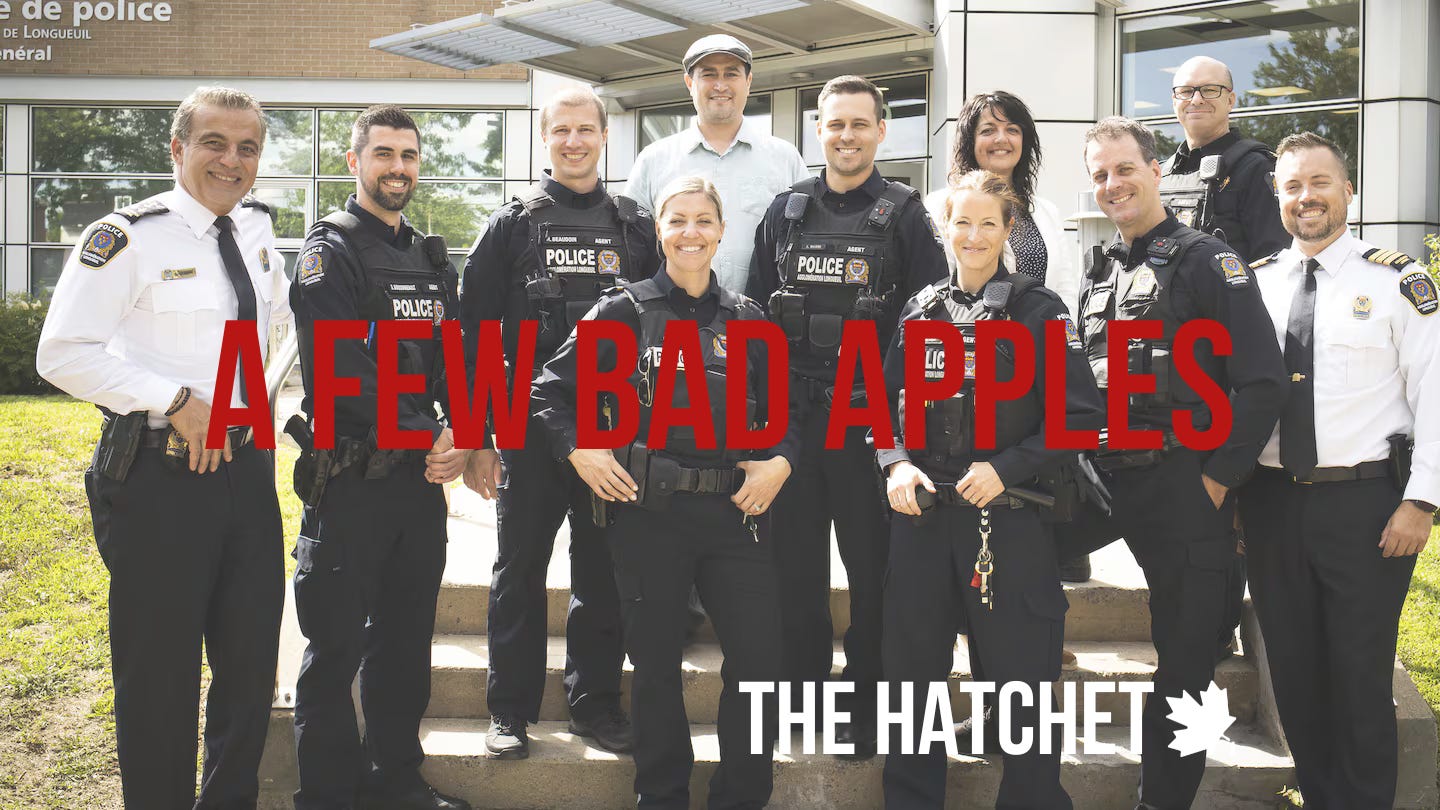
On September 21, 2025, the Longueuil police shot and killed Nooran Rezayi, an unarmed fifteen-year-old boy. The specific circumstances around his killing were shocking enough. But another aspect that stood out was the fact that the Longueuil police service had been the subject of enormous praise over the past few years for its efforts in community policing.
Below is an excerpt from our interview with Ted Rutland, an associate professor at Concordia University, about why community policing initiatives keep failing and what can actually be done to reduce to police violence.
This is part of our ongoing look at the killing of Nooran Rezayi. If you haven’t already, please take a look at some of our previous work on the subject:
“The Killing of Nooran Rezayi”
“Quebec cops killed a teenage boy. Now they’re targeting his friends.”
The Hatchet: One of the things that I was really interested to learn from your piece in The Rover was that the Longueuil police have been media darlings over the last few years, and have been held up as an example of everything that a good police force should be doing. Could you tell me just a little bit about how they got this reputation, and whether it was an earned one?
Ted Rutland: It’s certainly not an earned one. The escalation of the Longueuil police to the status of media darling began when a person named Fady Dagher became the police chief. And Fady Dagher is an ethnically Lebanese person who grew up in Africa, and was a police officer in a very racialized neighbourhood in Montreal called Saint-Michel for many years. He became the head of the neighbourhood police precinct, and was already establishing a brand as the person who wanted to humanize the police, who wanted to create a different kind of police force.
And when he was hired as the chief of the Longueuil police, he was given free reign to change the practice of the police, and certainly the image of the police. One of the things that he did is create a program called RÉSO, which essentially put police officers in the community without uniform, without a weapon for six weeks to get to know community organizations and the communities that the police normally target.
So that meant poorer communities, racialized communities, people suffering from mental illness etc. And I guess the idea is that somehow in those six weeks, the police will learn a kind of empathy and understanding that will lead to them being different kind of police officers when they pick up their uniform and their gun again.
And the media loved this. Radio-Canada created a 10-episode TV series called, in English, The Avant-Garde Police, which was all about this radical experiment in Longueuil of doing policing differently.
And of course, neither the media in those 10 episodes nor just media coverage in general did the obvious thing and question whether this is actually new or not — and it’s not — and two, think about whether this is actually changing anything or not — which it wasn’t.
And so in the article I wrote for The Rover, I try to show that what you had in the last four or five years was two things: you have the expansion of RÉSO and these sort of community policing programs that give the police a wonderful image, but that obviously don’t change anything in terms of how the police actually operate. And second, this new anti-gun squad, which was a mechanism to harass, shake down, and arrest racialized youth and young adults.
And to me, that’s not uncommon at all. There’s a famous book published in 1978 called The Iron Fist and the Velvet Glove by Tony Platt, and it looks at the way that the police in the 1970s were changing in two ways. One was towards increasing repression and violence, a more militarized form of policing — SWAT teams, advanced weaponry, new kinds of technologies, intelligence, surveillance etc. And the second was the velvet glove of community policing.
I don’t really think I said much in The Rover article that wasn’t said in 1978. Since the late ‘70s, we continually have these two kinds of advances of increased violence and repression and increased public image management and community relations that translates into positive media coverage. But it also does win over some members of the community.
And so we don’t live in a police state — as much as I find it fun to say that at protests sometimes. We have a police force that does require some level of community consent. And so one of the things that community policing does is it wins over some members of the community through these promises of engagement, reform, and change.
And so they end up providing some kind of legitimacy and support as the police are expanding violence in their neighbourhoods.
Why is it that we then keep returning to this idea of community policing? Because, as you said, since the ‘70s, you could look at any city in North America, and I feel like every 10 years you’re going to have a new initiative that claims we’re doing things entirely differently and we’re focusing on “community policing.” And it seems that police leadership often get a lot of runway if they use those words.
Why is it that we keep repeating this over and over and over if it doesn’t actually work?
I think about this question all the time. And my answers are provisional. It’s easy enough to understand why the police keep offering this, because when they’re advancing these supposedly new community policing initiatives, it’s in moments where they’re being protested, they’re being confronted.
It’s when people are contesting their violence, their power, their unaccountability, and sometimes, their budgets. And so what they have that they can offer that will quell some of that resistance and maintain their existing power and resources is community policing. So that part doesn’t seem like any kind of mystery to me.
Why the rest of us buy into this is much more complex. One of the things I would say is that the media are not especially interested in the history of the police. They’re not especially interested in thinking structurally about the police. Politicians aren’t either.
If we look at Montreal, we’ve had a series of liberal and sometimes even progressive governments since the 1980s that would probably like the police to be less violent. But they also need the police to ensure a particular kind of order to enable real estate investment, to convince people who would otherwise live in the suburbs to gentrify the city, to create a feeling of safety for tourists, to have people out in the evening spending money etc.
So I think that police violence is central to the kinds of politics that we have. It serves a certain purpose. It enables profit-making. It enables governments to hold power and raise revenues. And so I think to, to a large extent, the people who hold the power to change things don’t really want to change things. And community policing offers them a way of saying “we’re changing things, we’re taking things seriously.”
