


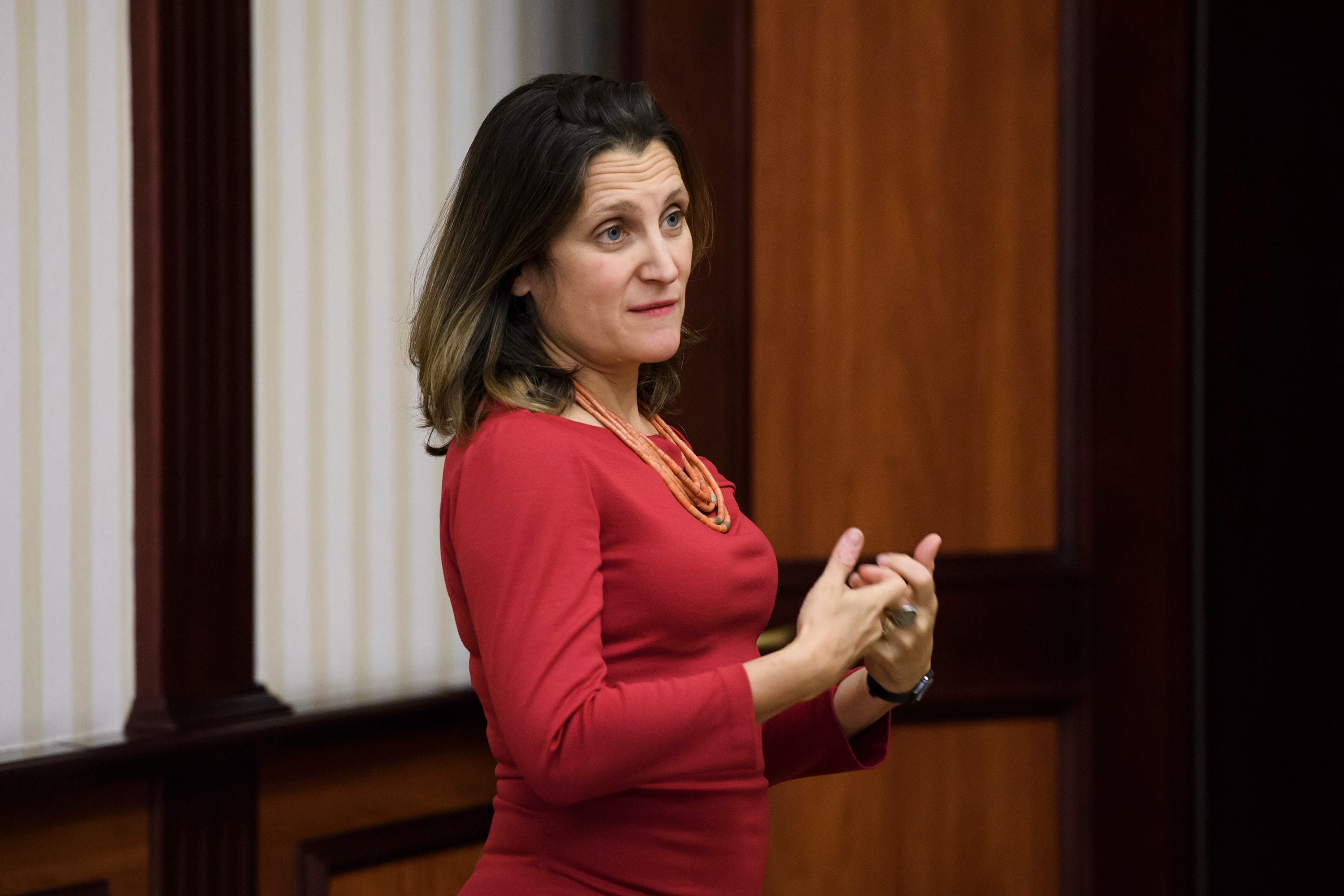
Chrystia Freeland hasn’t typically been thought to have a flair for the dramatic. That reputation has always belonged to her boss, a man whose political ascendancy began when he quoted Shakespeare at his father’s funeral and was cemented by pummelling a Conservative senator in a boxing ring.
And despite being a media darling for the first five years of the Trudeau government, her former colleagues in the press have increasingly come to portray her as an out-of-touch elite, straddled with an inability to communicate and a penchant for hectoring Canadians. (Though to be fair to her, I have indeed recently cancelled my Disney+ subscription). Freeland was never quite a PM-in-waiting (maybe waiting to be a PM-in-waiting?), but over the last year, her path to 24 Sussex narrowed to the point of invisibility.
And now all of a sudden, Chrystia Freeland has the whole country’s attention.
Her resignation, but especially her stinging rebuke of Trudeau, seems to have opened up the door once again to the top job. In her letter, she took aim at Trudeau’s “costly political gimmicks” and urged the necessity of “keeping our fiscal powder dry” for a potential trade war with the United States. According to reports, she was given a standing ovation from her Liberal caucus colleagues on Monday night, which could certainly be a read as a gesture of support for her actions.
Many in the media have started to draw up comparisons to John Turner and Paul Martin, two Liberal finance ministers who fell out with their bosses. And in both cases, fiscal issues were at least partially to blame. Turner had been unenthusiastic about implementing Pierre Trudeau’s wage-and-price controls. And as for Martin and Chrétien, their relationship began to fray during the high-stakes budget fights of the 1990s, and finally broke over Martin’s open leadership campaigning in 2002.
By comparing Freeland to Turner and Martin, journalists are inviting an obvious inference — the latter two eventually became prime minister, though with differing levels of longevity.
But Freeland has less in common with the 17th and 21st Prime Ministers of Canada than it may appear at first glance. Both Turner and Martin were the leaders of a more market-friendly and pro-business wing of the Liberal Party. They had consistently represented that faction at the cabinet table, pushing against the LPC’s left flank. Freeland, by contrast, was given the financial portfolio only after Bill Morneau, Bay Street’s de facto ambassador to Parliament Hill, resigned, ostensibly over the government’s pandemic-era spending.
I’m far from the first journalist to note that as finance minister, Freeland hasn’t exactly been a deficit hawk. For better or worse, she has embraced a variety of fiscal styles during her tenure, but none have been of the cost-cutting variety. And regardless of the merits of those policies (many of which I think are more than defensible), Freeland certainly hasn’t cultivated a loyal following of pro-growth politicos.
In fact, no such faction exists within the Liberal Party of Canada. Because there are no factions within the Liberal Party.
And that’s where Freeland’s dilemma lays.
In her excellent profile of Trudeau’s chief of staff Katie Telford, The Globe and Mail’s Shannon Proudfoot noted that this lack of factionalism in the LPC is a direct result of the internecine fighting of decades past.
After the intramural Liberal wars of the Chrétien-Martin period, part of the renewal of the Trudeau era was a declaration that there were no hyphenated Liberals with factioned loyalties any more.
Instead, this incarnation of the party has functioned as a cult of personality wrapped around one man and his control centre: Justin & Katie & Co. That sort of thing creates its own convenient gravitational pull – until suddenly, one day, it doesn’t.
And aside from Trudeau and Telford, no one has done more to reinforce this cult of personality than Chrystia Freeland. When Jody Wilson-Raybould and Jane Philpott objected to the prime minister attempting to improperly influence a criminal investigation on behalf of one of Canada’s most corrupt companies, it was Freeland who was Trudeau’s most loyal public defender.
Even after her resignation, Freeland seems unable to fully shake this deference to the prime minister. She’s reported to have shared a hug with Trudeau during Monday night’s caucus meeting. Needless to say, Turner and Martin would never — Turner left Pierre Trudeau’s caucus, while Martin and Chrétien stopped speaking to each other.
And above that, it seems clear to me that this factionless approach has dulled the political instincts of most Liberals. When Wilson-Raybould and Philpott left the party, they were heavily courted by the Greens, which was threatening to surpass the NDP in relevance at the time. Two cabinet ministers defecting to a minor party on the rise could have made a durable impact on Canada’s political landscape.
Instead, they chose to sit as independents. Wilson-Raybould said that was “the best way to transform our political culture.”
It was not. Neither are in Parliament today.
Bill Morneau followed a different, but similarly ineffectual path. Instead of trying to promote an alternative economic strategy from the backbenches, Morneau has contented himself by sniping at Trudeau in the press, always implying that the Liberals wouldn’t be in such trouble if they’d only listened to him.
Even this week, as the Prime Minister is stuck in one of the worst political crises of his tenure, and while the LPC is polling more than 20 points behind the Conservatives, few Liberal MPs are willing to publicly call on Trudeau to resign.
Trudeau has jokingly characterized all of this as a “family fight.” And in some ways he’s right. Few people believe that Freeland resigned because of serious, ideological disputes with the Prime Minister. It’s because, like so many ministers before her, she was undermined by the PMO. She was once on the inside, and now she’s on the outside.
Had Freeland actually stood for something independently, then she might have been able to use this dramatic exit to propel her to a higher office. But as it stands, all her sound and fury signifies nothing.
.. quite possibly ‘the best take’ .. I’ve a few mischievous ‘word edits for you.. haha ! 🦎🏴☠️🧨